Sunday, June 30, 2013

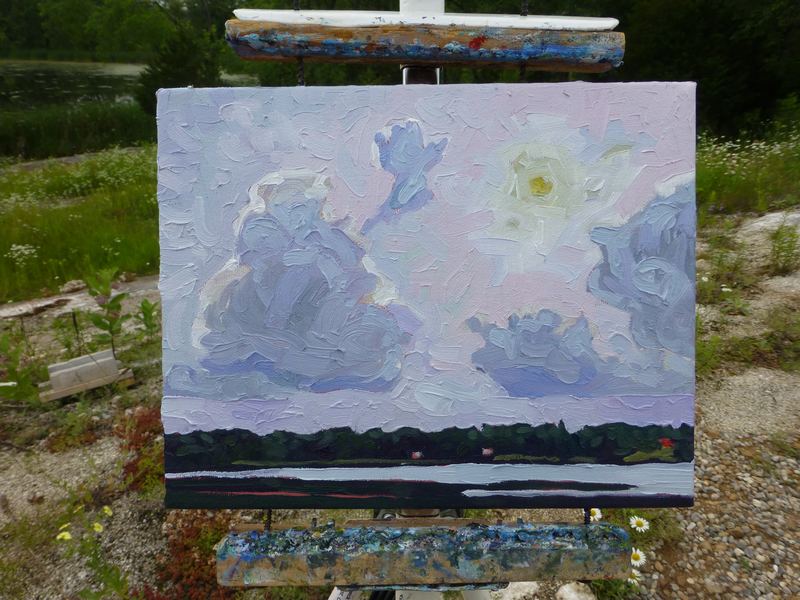
Backlit Cumulus

The hot and muggy air returned with the warm front that wriggled back and forth over eastern Ontario. My chores were done and I wanted to play with the clouds. The back lit cumulus were dark in the centre with a halo effect of the sunlight shining through the fewer water droplets on the outer edges of the clouds. The veil of clouds in the upper reaches of the atmosphere are the leading edges of north to south line of thunderstorms still over Peterborough. They eventually arrived overnight at Singleton Lake.

Oils on rose coloured acrylic tinted foundation on commercial canvas - 8 X 10 (inches)

Saturday, June 29, 2013

Hot Sector

It was the "hot sector" and not just the "warm sector" of the weather system to me. It was stil "hot" even though the warm front had just slipped south of Singleton Lake in the wake of a small low rippling along the frontal surface. The low level stratus fractus pieces where shaped by the weak northwesterly winds - as were the developing cumulus. The air mass was also quite unstable even at 10 am. Gravity waves aloft revealed strong westerly winds. The hot and muggy air would return in the afternoon and the frontal zone would likely be the focus form more thunderstorms. The moisture dripped down my back. The water was absolutely calm. All of this played out in the skies above but I doubt if anyone else noticed or even cared.

Oils on cobalt blue acrylic tinted foundation on commercial canvas - 8 X 10 (inches)

Friday, June 28, 2013

Canada Day 2013 - Preparations - Part Two

In my Blog entry “Two Paintings for the 50 Years of Our Flag Project” I explained the insurance policy reason for completing two paintings when only one was commissioned. I believe in service and doing ones very best. As well I wanted to please! I was labelled as an “over-achiever” in school and I never really knew (or cared) if they felt it was a good or bad thing.
The sibling painting is #1301 called "50 Years of Our Flag". I needed a different title so I just went with the main point of the entire project and focused on the anniversary of our flag. This painting was started on December 20th, 2012 along with #1300 "Celebration of 50 Years of Our Flag".
It is not an exact copy. Some of the weather and shapes are different. I made some changes for personal, artistic and compositional reasons but they are neither right or wrong – just different. The meteorologists in the crowd will immediately notice that the turbulent stratocumulus in the westerly flow behind the cold front has been replaced by cirrus approaching Killarney Light! The importance of this change in cloud type will be a 10 mark question in the accompanying exam.  There is also no bunny in the towering cumulus over the Oak Ridges Moraine!  This painting is still close to the original and approved commissioned design. I do not enjoy copying something and after all, art and life are supposed to be fun! Creativity is seldom achieved when one is in the act of simply replicating something - even if that something is nature or something you love.

This second similar painting was completed simply to support the "50 Years of Our Flag" Project. The details of this excellent project can be found at http://www.50yearsofourflag.ca/

The painting will also be sold through a bidding process. No prints are planned for this painting. Contact either me or Bob Harper (bob@50yearsofourflag.ca)

By the way, the 2013 Canada Day Weather in Brockville looks ideal with a pleasant outflow from a high parked over James Bay - enough to unfurl any flag. A weather system passing south of Brockville should bring in some high cloudiness but the associated rain will stay south of the St Lawrence River - even if I have to do my patented "rain dance"...

Thursday, June 27, 2013

Canada Day 2013 - Preparations - Part One

In preparation for Canada Day 2013, Painting #1300 "Celebration of 50 Years of Our Flag" is complete and presented here it is for the first time.
The mission of this painting was to "wrap the Canadian Flag in Canadian art". The historic Flag Committee was formed in 1964 to find the elusive symbol that would be used around the globe to ever after identify the uniqueness of Canada. The Group of Seven and Tom Thomson had a similar goal in the early 20th century “to create a distinctly Canadian expression of art." The Group of One (that’s me) wanted to achieve the same goal in the early 21st century. Canada is distinctive. The land, water and weather are unique. The Canadian Flag is truly unique and the one of the most recognized symbols world-wide. The paintings that embrace the flag are my favourites but were selected by Bob Harper and John Ross Matheson as fitting tributes to the 50 Years of Our Flag Project. There are many stories to be told. The painting and its background is a course in Canadian history, nature, art, science, sport and of course weather.
The painting was started on December 20th, 2012 but that was just the tinting start of a project that would take many months. The first step is called " "imprimatura" " which comes from the Italian for "first paint layer". The first paint applied to the virgin canvas was thus a mixture of quinacridone/naphthol red oil which exactly matched the colour of the Canadian Flag. I have done this for many years but felt it should be explained in relation to the "50 Years of Our Flag" Project. The details of this project can be found at http://www.50yearsofourflag.ca/

The painting will be sold through a bidding process. This is the one that will be printed with as many copies that are desired. Contact either me or Bob Harper (bob@50yearsofourflag.ca)
I will unveil the sibling, insurance policy painting tomorrow...

Wednesday, June 26, 2013

Brockville, Birthplace of the Canadian flag, celebrates July 1

On Monday July 1st, Canada Day, our country’s Maple Leaf will rule Brockville’s skyline following a 3 pm ceremony commemorating the birthplace of the Canadian flag. Following all the activities and hoping to attend will be former resident John Ross Matheson. Now 95 years old, Matheson is considered by many as the father of our flag.

The event will mark the kickoff to the “Fly More Flags” campaign, a fundraising effort aimed at encouraging local businesses to fly a Canadian flag, spearheaded by the local “50 Years of Our Flag” committee.

Brockville’s 120 foot commemorative flag pole has been made possible by the generosity of Mitchell Goldhar and SmartCentres, as part of the company’s own ongoing commitment to install more Canadian flags on its properties across the country.  It also represents one of a series of initiatives leading up to the 50th anniversary of the Canadian flag on February 15, 2015 aimed at bringing awareness to all Canadians about the effort undertaken by many individuals over more than 100 years to bring Canada its distinctive National Flag.

 The base of the pole is 55 cubic metres of concrete weighing 290,400 pounds. The 20 by 40 foot flag will not move... The flag is 2296 feet from the study where John Ross Matheson did much of the background work and study for the flag and Flag Committee. The flag is even closer to Toniata School on the eastern edge of the image where I was going to school at the time of the Great Flag Debate.

In September the flag pole will be raised to 160 feet and fly a 35x70 foot flag. An electric winch is required top raise and lower a flag this large. This flag will be the largest on the Macdonald–Cartier Freeway and visible for miles! I forecast that there will be enough breeze to keep it unfurled. The flag will certainly be a sight!

Monday, June 24, 2013

Aleta Karstad - Plein Air Painter and Friend!

Aleta is currently in New Brunswick as the Artist in Residence in association with a very important Bio-blitz. She is really busy recording the special beauty of endangered species and habitat. Meanwhile her very learned, naturalist husband Fred studies the flora and fauna. This typically involves wading waist deep in marshes collecting samples. Together they produce a wonderful body of knowledge and art that hopefully will both educate and inspire others to care about the natural world that surrounds us.
Aleta and I have painted together on many occasions.
http://karstaddailypaintings.blogspot.ca/
Meanwhile back at Singleton Lake I have deployed all but one of my turtle nest protectors. There are turtles wandering around everywhere looking for that perfect spot to dig a nest. They don't seem to like my suggestions or the areas that I have prepared for them.

Sunday, June 23, 2013

NinJa Turtles

I try to protect the turtles... the raccoons and skunks like a feed of turtle eggs. The predators need to eat too. Perhaps I am interfering by protecting a few turtle nests. 
I have built a dozen of these turtle nest protectors. They seem to work very well. The difficulty is in locating the nest. Turtles may have a reputation for being slow but they disappear like NinJa Turtles the minute I turn my back. They use their "slowness" as a guise and give you the illusion that you don't have to watch them like a hawk to keep track of their movements. The undiscovered nest beside the one that was protected (lower right) was predated by a raccoon. 

Any turtle that hatches out when I am around gets a free ride to the lake... In 2012, 29 baby snappers enjoyed the free ride out of one nesting cavity - like the baby northern map turtle above. 


The following is from Wikipedia:
Northern map turtles breed in the spring and fall. Most mating takes place in deep waters. The nesting period lasts from May to July. Unshaded sites with sandy soil is highly preferred. The female usually chooses well-drained areas for depositing the eggs. The nest cavity is dug with the hind feet. The size of the clutch is between 6 to 20. The eggs are oval, about 3.2 cm (1.3 in) long, and have a flexible shell. After the eggs are laid, the cavity is filled. They hatch after 50 to 70 days of incubation, and most hatchlings emerge in August to September. When a nest hatches late, the northern map turtle hatchlings have been known to overwinter in the nest. The female usually lays two or more clutches in one breeding season. The sexes of the young are determined by the temperature. At 25 degrees Celsius incubation produces a majority of males whereas 30–35 °C (86–95 °F) yields more females.

Sunday, June 16, 2013

Arabella Canadian Landscape Contest

http://arabellaworld.com/As if life isn't busy enough I am also a participant in the Arabella Canadian Landscape Contest - Capturing the Beauty and Emotional Spirit of Canada. It was a natural reflex for me to participate. I entered three paintings that I completed just before embarking on the "50 Years of Our Flag" Project. Both endeavours  promote the passion we share for Canada. These paintings were completed as I also constructed the Singleton Lake Studio and Home... let's hope that they are worthy tributes to the beauty of Canada.

The following is from the ACL website and it details how you can vote for the people's choice award. There is a lot of fine art! I invite you to take a close look at it all. The above image and this link takes you to the Arabella Launching Pad - blast into Canadiana from here. Here is a link directly to my Arabella page... 

"Share Your Love of Art! Share Your Love of Canada! ARABELLA invites you to become a part of our Great Canadian Landscape Painting contest!  Register and cast your vote for your favourite artists and their works!

Contemporary art plays an important role in telling Canada’s story. Over 100 artists present you with an outstanding collection of more than 300 contemporary works portraying the emotional power of landscape art in shaping Canadian identity in different parts of the country."

Tuesday, June 11, 2013

Rain

I wanted to capture the atmosphere of heavy rain without painting every rain drop .. I set up under the front porch and looked across the field at the stand of tall white pines on Long Reach Lane. It was a bit chilly and certainly damp. This is the fourth painting in this weather series that started with cirrus and progressed through altostratus to rain clouds and finally rain.

The rain just kept pouring. There is a "sweet spot" north of the upper storm centre where the eastward translation of the system (with respect to the earth) is balanced by the westward flow of the rain clouds north of the storm (with respect to the atmosphere). These opposite and equal motions balance each other out. The net result is that the portion of the storm producing heavy rain can be nearly stationary over the "sweet spot" on the earth's surface. Really heavy rainfalls can accumulate locally and catch people by surprise. I had better go and bail the boat. I was not surprised though.