Tuesday, April 8, 2025

Tom Thomson's "The Hill in Autumn" 1914

My first diagnosis of "The Hill in Autumn" really troubled me! Some subtle inconsistencies bothered me enough that the story did not get published in the first go-round. The puzzle pieces did not fit together as nicely as they should. Was Tom looking east or west? Were the coniferous trees in the centre of the painting in shadow (looking easterly), or were there no deciduous trees there because of soil conditions?

The illumination of the scene was sufficient to bring the colours out of the forest. The sun had to be a least a bit on Tom's back or at least overhead. The clouds were no problem, but I needed to be certain of the direction of view! Was that storm coming or going? Let me explain... please. 

"The Hill in Autumn" Fall 1914
Oil on composite wood-pulp board
8 7/16 x 10 1/2 in. (21.5 x 26.7 cm)
Tom's paint box size, 1914.72

My friends Jim and Sue came to the rescue again! The "paddle in the water explorations" of the Waddingtons were instrumental in correctly solving the riddle of Tom Thomson's "The Hill in Autumn" from 1914. We must also acknowledge Tom Thomson for painting exactly what he saw. Tom did not make anything up! 

The Waddington image from Broncho Island on the left with "The Hill in Autumn" to the right. 

A picture is indeed worth a thousand words. Tom, along with pretty much every artist I know, will distort the subject to better fit the size of the painting surface that they have available. Tom scrunched the horizontal dimensions, but the details remain unmistakable. 

Jim wrote: "It was quite windy, so I think we tried to land on the north-western end of Broncho Island to take the photo. That was difficult too." 

The photo was taken looking west. The topography matching Tom's painting was unmistakable. 

Jim writes further: "I have since learned from the Voyageur Outfitting site about their island retreat. The Island was once a 'camp' of Tom Wattie, who was an Algonquin Park ranger from 1900-1931. Tom Thomson was also a park ranger at this time and became good friends with Wattie, visiting him often at his camp, now known as the Algonquin Island Retreat."

Bronco Island is on Kawawaymog  Lake, which was formerly known as Round Lake. 

Jim and Sue also observe: "Thomson probably wasn't in the middle of the lake like us but was on one of the islands, presumably Wattie's".

With the viewing direction firmly established, I could make progress on the meteorology in Tom's painting. The skyline was at the lower third of the small panel, so the subject that caught Tom's attention was most certainly the weather. 

It was a windy day as well when Tom made his weather observation. Mares' tail cirrus was overhead in an azure sky. Recall that backlit cirrus is not dark in its centre like more opaque clouds. Cirrus ice crystals are just not present in sufficient density to block the sunlight. 

The shape of the cirrus cloud elements is all we need to establish both the average wind and the deviations from that mean, which sculpt those intricate patterns. It is easiest to just witness the cloud drift across the sky to establish the average wind. The entire mass of moisture simply moves along with the mean flow. For example, I was able to easily follow the motion of the mares' tails depicted in the following graphic, so I knew the direction of the average wind. That is not possible with a still image, but the shape crafted by the relative winds can still reveal the mean. 

The cloud shape revealed that the average wind at cloud level would have been from right to left, as depicted in the painting and in the actual clouds I photographed. Thus, the upper winds were from the north since Tom was looking toward the west (thanks to Jim and Sue). The following graphic details these deductions and will serve as an introduction to cloud watching. Actual mares' tail cirrus are included along with Tom's interpretation of what he witnessed. 

See "A Jet Streak with a Paddle" for an explanation of the atmospheric frame of reference.

The following graphic applies the above concepts to the still images of mares' tails in Tom's "The Hill in Autumn". Remember that clouds are three-dimensional and exist through a depth in the atmospheric ocean, although we only witness planar views, especially in the painting. For example, the green col symbol at the leading edge of the cirrus is probably at a higher level than the swirls sketched. The col and lines of the deformation zone conceptual model must be continuous in the view of the processes on a piece of paper. 

Try to visualize the swirls as three-dimensional vortices tilted forward with the strong winds along. The col at the nose of the cirrus would be as sketched in the graphic. Any ice crystals wafting groundward would be caught in the vortices that flank the local wind maximum embedded within the mean flow. These processes neatly explain the swallow-like appearance of the cirrus uncinus, which is what really attracted Tom's attention in the first place! 

My COMET friends in Boulder could manufacture a wonderful animation of this dynamic structure and make it come alive! For now, please try to play that image in your mind using your Coriolis hand. My efforts to explain this in the weather centre were typically unsuccessful, but I never give up. Also see "A Closer Look at Lines in the Sky" which is one of several explanations of deformation zones and the important role that they play in understanding moisture patterns in any fluid.

I was in the Studio and decided to manufacture a three-dimensional representation of the planar view of mares' tail cirrus. In the image, using my Studio step stool, the wind increases with height from the floor through steps one and two. The strongest wind is in the direction of my mahl stick (circa 1966) positioned at the very top of the stool. 

The wind spins the paper towel rolls in the sense indicated. The "cloudy" white roll to the left (looking downstream) of the local wind maximum spins cyclonically (the red arrow) - the thumb of your Coriolis hand will be pointing up.  The "blue sky" roll to the right (looking downstream) of the local wind maximum spins anticyclonically (the blue arrow). Your Coriolis thumb will be pointing downward.

The wind is strongest at the level of the mahl stick, so both of these rotating vortices are tipped forward with the wind. The moisture is also advanced furthest downstream at this level, represented by the cushion at the tip of the mahl stick. 

Now visualize the ice crystals from the cirrus caught up in these vortices drifting toward the earth - gravity gets us all eventually! I draped the towel sheets to try to represent how that might look. 

The final visualization is a quasi-horizontal cross-section through the towels and mahl stick, integrating what one would see from the ground, seeing all of the different layers of the three-dimensional moisture. 

Now back to "The Hill in Autumn". The wind direction at the surface can be quite different from that revealed by the cirrus above 20,000 feet. In this case, though, we can be quite certain that the winds were brisk and chilly northwesterlies.  

The blue skies and clear visibility were characteristic of a ridge of high pressure over Tom. Air generally subsides ahead of a ridge, and the pressure at the ground rises with the fair weather.  That's why people have barometers on their walls. The air was dry, and there was not even a hint of cumulus clouds under the sunny skies. 

Winds are generally calm in a high-pressure centre. The wind speed inducing the waves that Tom painted would only be found in the anticyclonic flow ahead of the ridge or after the ridge had passed. The former is certainly the case in this situation as the cirrus is not a large deck of cirrostratus but rather isolated, thin mares' tails. Cold air advection is also much more likely to bring the momentum of stronger winds aloft descending to the surface. Recall the constant energy trajectories that air parcels follow, sloping downward to the ground as they head south. See "Isentropic Surfaces - Science and Art Merges" for more explanations and details. 

The other important part of this puzzle can be seen on the western horizon. Bands of rose-coloured cloud stretch along a deformation zone that encloses the warm conveyor belt of an approaching weather system. Tom painted bands of cirrostratus within gravity wave swells being stretched by the deforming flow. 


Like in the ocean, the atmospheric swells propagate outward from the source but are most significant in the same direction as the strong winds that generate them. Using the westerly nature of the jet stream and this fact would be enough to realize that Tom had to be looking toward the approaching storm. I felt that the swells in the cirrostratus might not be sufficient evidence, even though I was convinced. I can be pretty gullible. 

Separately, each puzzle piece described above cannot fully diagnose the weather pattern. However, the pieces can only fit together in one way to make meteorological sense. The following graphic summarizes how the mares' tail cirrus, strong northwesterly upper winds, brisk northwesterly surface winds and distant swells of cirrostratus must fit together. It may not be rocket science, but I still think the story is a blast. 

A similar parade of weather occurred on April 7th, 2025. The sky overhead Singleton included a few patches of mares' tail cirrus, which I watched to establish the northwesterly flow aloft in an earlier graphic. Some cirrostratus was low on the horizon but too subtle for an interesting picture. The sky changed dramatically in just an hour or two. The approaching storm was racing toward the east. The following graphic describes those lines in that sky. Weather is important. 

Here is that same view at noon the following day. Winter had returned to Singleton. The intensity and speed of the weather system could be inferred from those lines in the sky. I spend a lot of time looking up at the sky - time well wasted!


I consulted with my weather friend Johnny Lade.  John made the following excellent observations:

"I always look for the western horizon. Maybe from thirty years of doing weather observations and looking for a deformation zone. In my ground school teaching, I always told my students to notice trends. Always watch the weather on TV and feel the weather.  
So, in your description, the first day of a high is windy, too windy for my pilot friends to go up and do cross countries. The second day and into the third day will be fine before the strong westerlies develop. I have a barometer on the wall by the door in my house to follow trends.
I have favourite clouds. This painting has mare's tails and invading altocumulus! "

John and I spend a lot of time marveling at the weather. We are perpetual students and always happy within our natural laboratory. 

The "The Hill in Autumn" was another painting comprising the very tall stack of panels salvaged from Thomson's Shack in the spring of 1918. Harris and MacDonald enjoyed a relatively easy time naming this work. The painting depicted a prominent hill, and the deciduous trees were the colours witnessed in autumn. There was no need to discuss the clouds in the sky even though they were the subjects of Tom's weather observation. 

The determined investigations of Jim and Sue Waddington were essential to unravel the real story behind Tom Thomson's "The Hill in Autumn". The science comes to life when we can be certain that Tom was looking west while he painted. Thank you!

Inscription recto: 
  • l.r., estate stamp Inscription verso: 
  • c., estate stamp; 
  • u.l., in graphite, AM; 
  • u.l., in graphite, 8; 
  • c., in graphite, 6A (or 46A); 
  • below stamp, label, in graphite, The Hill in Autumn / 
  • 1914-J and in ink, Dr. James MacCallum National Gallery of Canada, Ottawa 
This was another one of those panels that caught the eye of Tom's patron, Jim MacCallum. The good doctor must have made the acquisition when the panel surfaced during the sorting and naming process in the spring of 1918. 

Provenance:
  • Estate of the artist 
  • Dr. J.M. MacCallum, Toronto 
  • National Gallery of Canada, Ottawa. Bequest of Dr. J.M. MacCallum, Toronto, 1944 

"The Hill in Autumn" as it would have
appeared in Tom's pochade box.
To really appreciate Tom Thomson, it is important to place his art within the context of the times, in addition to the science and the weather. The so-called Great War was raging in Europe and consuming the full attention of his friends. Meanwhile, Tom surrounded himself with the wonders of nature in Algonquin Park. 

In "The Hill in Autumn", Tom actually captured the swallow shapes of the tilted vortices associated with a local wind maximum in the upper atmosphere - cirrus uncinus. This was a skyscape painting. Paint on Tom!

For those interested in a bit more science, I also wrote about "Curly Hook Cirrus" in "Lines and Swirls Explained".  Also in "A Jet Streak with a Paddle" I explained why deformation zones parallel the wind in the entrance region of a local wind maximum. In sharp contrast, the deformation zones are perpendicular to those winds as they decrease downstream from the local wind maximum. These clouds can reveal a lot about the atmosphere. These discussions were a tough sell in the Weather Centre when the pressures of deadlines and workload precluded a more artistic investigation of the "why" behind the clouds.

Warmest regards and keep your paddle in the water,

Phil Chadwick, Tom Thomson Post TT-114

PS: Tom Thomson Was A Weatherman - Summary As of Now contains all of the entries to date. 

PSS: Should you wish to have Creative Scene Investigation applied to one of Thomson's works that I have not yet included in this Blog, please let me know. It may already be completed but not yet posted. In any event, I will move your request to the top of the list. If you made it this far, thanks for reading! 


Tuesday, March 18, 2025

Tom Thomson and the 1915 May Two-Four Weekend

Something very rare happened on the "May Two-Four Weekend" in 1915. A volcano that had been sleeping for about 27,000 years suddenly woke up at about 4:00 pm Saturday afternoon. Lassen Peak in northern California produced a violent explosion that ejected rock and pumice high into the atmosphere. This explosion was the most powerful in a series of eruptions from 1914 through 1917.

On May 22, 1915, an explosive eruption at Lassen Peak, California, the southernmost active volcano in the Cascade Range, devastated nearby areas and rained volcanic ash as far away as 300 km to the east. 

Tom Thomson was staying at Mowat Lodge on Canoe Lake, busy painting before the black flies emerged and waiting for guiding and fishing to occupy his time. Tom would have been oblivious to how a faraway volcano might influence his choice of pigments. Thankfully, Tom painted what he saw.  

World War One, the so-called first "Great War" was still raging in Europe. Tom's artist friends had dispersed to participate in that conflict in one way or another. Sadly, they were unable to accompany him on his last artistic adventures which ended prematurely with his death in July of 1917. On the positive side, Thomson was finding his own, unique artist voice and creating magnificent work.

Three years later, in the spring of 1918 Lawren Harris and J.E.H. MacDonald faced a virtually impossible task to sort through the two or three hundred panels that Tom had created in their absence. The undocumented panels were stacked high in Thomson's Shack. 

His friends attempted to sort through the paintings selecting what they felt were the best works to establish Tom's legacy. The Estate Stamp applied to the front and back of the panels would authenticate his art. Tom only signed the panels when asked to do so. He certainly never bothered to put names on his paintings. In fact, Tom rarely made any mention of the inspiration for his paintings leaving the art to speak for itself.  As a result, this was a gargantuan but essential task for his friends. Many of Tom's originals had already dispersed to the wind to anyone who took a passing appreciation for his brush strokes.  

The estate stamp typically in the lower right often resulted in some paint eventually flaking off. The panels salvaged from The Shack and organized in the Studio building all display the stamp.

Harris and MacDonald certainly were enthralled with Tom's art but had little or no first-hand knowledge of the story behind them. They had to rely on their own devices to create plausible titles based on the subject matter and possible locations. MacDonald had never been to Algonquin. Well-intentioned mistakes were made. These are easily forgiven. Those errors still remain in the Tom Thomson Catalogue RaisonnĂ© but there is hope!

Using science and topographical maps, we can correct those mistakes - something that I have been doing since the mid-1980s. As an example, it is interesting that more than a century later, we can trace Tom's movements on the Victoria Day weekend of 1915 using only his art and a volcanic eruption in California. Please let me explain. 

From detailed research into Tom's movements, we can be fairly certain that Tom was at Canoe Lake on the weekend of May 24th, 1915. Tom was likely staying at Mowat Lodge but occasionally ventured to his favourite haunt on Hayhurst Point less than a kilometre to the east. 

Thomson Travels 1915
  • March 13 – April 10: Ontario Society of Artists Forty-third Annual Exhibition, Toronto. Thomson exhibits Northern River, Split Rock and Georgian Bay Pines. Northern River is bought by the National Gallery of Canada for $500. His address is given as Studio Building, Severn Street.
  • Mid-March: Arrives in Algonquin Park, via Huntsville, where he stays at the home of Winifred Trainor for two days; he travels to Tea Lake and Big Cauchon Lake; in the Kearney area, he stays at McCann’s Halfway House.
  • A.Y. Jackson had returned to Quebec, evidenced by a letter to his sister Kate, dated April 18th, 1915, which he sent from Emileville Quebec. In it, he discusses his intention to join the army. His attestation papers show that he enlisted on June 14, 1915.
  • April 28 – May 19: Thomson and George Rowe guide the Johnston Brothers of Pittsburgh, Pennsylvania to Pine River; they travel to Tea Lake. On their return, Thomson and Rowe travel to Big Bear Lake.
  • May 24 Weekend...
  • July 17: Assists H.A. Callighen in bringing tourists from Joe Lake Station to Smoke Lake by canoe.
A case can be made that links four of the 1915 paintings using colours, the volcano, the parade of weather across Canoe Lake and science.

I propose that these four sequential paintings recorded every sunrise and sunset at Canoe Lake starting on the evening of Saturday, May 22nd, 1915 - the day that Lassen Peak erupted. The potential paintings are included in above. Brief explanations follow. Detailed analysis and diagnosis of each painting can be found in the linked blogs.  Please ignore the official names of the artwork which identify them all as sunsets - two of the four were certainly sunrises. 

Sunset, Saturday May 22nd, 1915
On the late afternoon of Saturday, May 22nd, Thomson was visiting his favourite site on Hayhurst Point. He recorded the backlit clouds looking westerly at sunset in Painting 1.  A spring weather system was approaching. The details are explained in Tom Thomson's Sunset Sky, Summer 1915. Harris and MacDonald were correct in identifying this as a sunset. I feel they missed the mark by identifying the season as summer perhaps because the name "Sunset, Spring" had already been used in  Painting 2. Tom typically spent his summer guiding and fishing. He did not paint much in the summer because of pesky biting insects. The clouds are also not overly convective as one would expect in mid-summer.  


Sunrise, Sunday May 23rd, 1915
At dawn on Sunday, May 23rd, Tom was on the shore in front of Mowat Lodge looking easterly to observe strong sunrise colours in the backlit clouds. The unusual sunrise colours would have penetrated Tom's room on the second floor of Mowat Lodge. Tom must have been compelled to grab his oils and make a weather observation. For a detailed analysis see Tom Thomson's Sunset Sky, Spring 1915. The terrain features of the eastern shore of Canoe Lake as well as those recorded in other Thomson paintings confirm the easterly view. The clouds also confirm that Tom was observing the wake of a cold front. The weather system that had been approaching at sunset on Saturday had crossed Canoe Lake overnight probably bringing precipitation overnight. 

Harris and MacDonald would have incorrectly interpreted the strong colours as a sunset sky unaware that the higher level volcanic aerosols transported by the jet stream had already arrived over Canoe Lake.

Tome would have been interested in the strong colours exhibited in the sky all day Sunday. There could be other paintings to include in this sequence. We can be certain that Tom paddled over to his Hayhurst Point haunt to observe the vivid sunset colours looking west. 

Sunset, Sunday May 23rd, 1915
The details of the analysis and diagnosis can be found in Tom Thomson's "Sunset" 1915. Harris and MacDonald called Painting 3 "Sunset" from the summer of 1915. They were certainly correct about the sunset part but the season was spring right after the volcanic eruption. Matching the terrain features confirms that Tom was looking westerly across Canoe Lake. The jet stream had already delivered the next low-pressure system in the parade of weather. This time the strong winds also brought thicker concentrations of volcanic aerosols dramatically influencing the sunset colours. Tom painted exactly what he saw!

Finally, Tom awoke on Monday, May 24th, 1915 to a brilliant sunrise streaming in his window of Mowat Lodge. Terrain matching again confirms his easterly viewing angle. 


Sunrise, Monday May 24th, 1915

The weather system that arrived at sunset on Sunday had passed east of Mowat. Tom was observing the sunrise light scattered from the underside of the cirrus and altocumulus cloud found in the "hang back - comma head" of the storm. The details of the analysis are recorded in Tom Thomson's Sunset, Summer 1915. Harris and MacDonald miss-named Painting 4 as "Sunset, Summer 1915" reusing the same name as applied to Painting 3. Understandably, the unusual sunrise colours tricked them again. They were also running out of unique names to employ. 
Tom must have been aware that something very unusual was happening in the atmosphere. This lends some rationale for Tom to diligently observe the increasingly spectacular colours in a series of paintings. Paintings number 1 and 3 in the above series are the only actual sunsets looking westward. 

Painting 1 Saturday sunset left -Painting 2 Sunday sunset about 30 hours after the eruption right

Painting 1 was completed just a couple of hours after the eruption well before the arrival of the volcanic aerosols. Painting 3 was completed with the arrival of the first high concentration of volcanic aerosols. The initial concentrations of aerosols can be very high behind the deformation zone of the airflow that delivers those particulates. Tom must have been amazed at the vivid sunset colours!

Paintings 2 and 4 repeated below are truly sunrises looking eastward from Mowat. The colours increased in chroma between Sunday morning on the left and Monday morning on the right. 

The progression of cloud types and structures is consistent with two separate weather systems that crossed Canoe Lake over the May Victoria Day weekend. Rain likely fell both Saturday and Sunday nights. 

In any event, Sunday supper on the Queen Victoria Holiday weekend would have been memorable - not only because of the "fireworks" in the sky. Annie Fraser, Shannon's wife was well known for her fine meals and baking at Mowat Lodge. (Note: May 24, Queen Victoria's birthday, was declared a holiday by the Legislature of the Province of Canada in 1845. After Confederation, Queen Victoria's birthday was celebrated every year on May 24 unless that date was a Sunday, in which case a proclamation was issued providing for the celebration on May 25.) The Great War was still raging in Europe and patriotic feelings would have been high. 

           Tom Thomson circa 1905-1910                 

To really appreciate Tom Thomson, it is important to place his art within the context of the times in addition to the science and the weather. 

What motivated Tom to record these weather observations? Tom must have been shocked to see the colours of the sunrise reaching into his bedroom window. I can imagine Tom grabbing his paint box and rushing out to the shore of Canoe Lake to chase the sunrise light before it disappeared. Tom was also a morning person... let's get going with the sun. Rise and shine.

Tom would have been eagerly waiting for the display of colours that the sunsets would deliver. That is why artists paint... we all chase the light in amazement at the beauty of nature ... and the weather. 

Tom might not have understood all of the science and would certainly not have known that Lassen's Peak had just exploded - but he was truthful to what he saw. In that way, the science he recorded must also be accurate. 

Warmest regards and keep your paddle in the water,

Phil Chadwick

PS: Tom Thomson Was A Weatherman - Summary As of Now contains all of the entries to date. 

PSS: If one searches Tom Thomson's Catalogue RaisonnĂ©  for "sunrise" only one painting shows up. If one searches for "sunset" 25 works are produced. Some of those sunsets are actually sunrises as we have demonstrated. Of course, it would have been helpful if Tom had left a few hints. 

Monday, March 10, 2025

ArtBridgeCanada - Taking the National Dream to the Web

 Art can be a way of life. It certainly is the path I follow, surrounded by nature. 

Creativity tends to be a solitary adventure of discovery in which mistakes and successes are all just opportunities for learning - getting better in your own eyes. Inspiration abounds everywhere and just asks to be imaginatively expressed. You control your journey, and who knows where it will lead? 

But there is more. Artists can share, inspire, and learn from one another. We are all in this together!  Long-time friends recently launched ArtBridgeCanada. The national non-profit employs the positive powers of the World Wide Web to connect artists, allowing them to collaborate and flourish. In many ways, this is a continuation of the dream of Tom Thomson and the Group of Seven to create a Canadian identity which is as unique as the landscape and the weather. 

The time has arrived to reinvigourate that national dream and foster the Canadian cultural identity. You will see me on the ArtBridgeCanada Advisory Council. There is room for more. 

“We believe that when artists thrive, communities thrive.” – Brian Usher, Executive Director


I only post about art and science. Both topics still make sense to me, although quantum mechanics is a stretch! I also prefer positivity. ArtBridgeCanada qualify on all three of these conditions. 

Warmest regards and keep your paddle in the water,

Phil Chadwick 


Saturday, March 8, 2025

Our Green Heart by Diana Beresford-Kroeger

The local librarians know exactly what I enjoy reading - nonfiction about nature with an emphasis on art and science. There is too much fiction in real life these days, compounded by the invasion of Artificial Intelligence. I much prefer authentic brilliance or even real stupidity. 

The last book has turned out to be a must-read! "Our Green Heart: The Soul and Science of Forests" by Diana Beresford-Kroeger ticks all of the boxes and then some! I learned something from each page. 

I have read countless nature-oriented books, including most of the books by Peter Wohlleben: "The Hidden Life of Trees", "The Inner Life of Animals", "The Weather Detective", "The Secret Wisdom of Nature", "The Heartbeat of Trees" and "The Power of Trees". That is a considerable amount of reading about nature and forests. Surprisingly, "Our Green Heart" provided many gems I had not yet discovered! 

Diana Beresford-Kroeger even touches on quantum mechanics. Quantum lifting is mentioned on Page 65, describing how photons interact with chlorophyll in photosynthesis! Amazing.

Here are just a few more of my favourites... 

On page 88 Diana describes the photoactivity of leaf mould explaining the lack of snow under a tree in the winter. I had incorrectly attributed that observation to the boughs of the trees. 

The decimation of insects and their absence on the windshields of cars is found on page 111. The increase in the 2.5-micron pollution index is associated with the increase in atmospheric carbon.  The pollution coats flowers preventing insects from feeding on the sugars the plants use as enticement. Both the flowers and the bugs suffer. 

Page 142 mentions how Ireland, New Zealand, Canada and Ecuador are giving legal rights and status as persons to the forests and rivers. This is something that Brehon laws embraced long before the British Empire and the Magna Carta. The entire world needs to adopt this approach - sooner than later!

Page 149 describes the ancient frozen carbon under the Arctic and the Boreal forest amounting "to approximately three times the tonnage of carbon in the atmosphere.... a sleeping time bomb".

Page 150 describes "the enormous spring flush of aromatic aerosols (that) ends in a global plume of airborne medicine." It is healthy to enjoyyour time in the forest. 

Page 140 holds a gem when Diana describes her "good friend, the late Harvard professor E.O. Wilson ... (describing) the present time as full of people with Stone Age emotions working in medieval institutions and thinking and acting from a belief in their own godlike prowess." Amen. 

The last paragraph on page 192 ends with a prayer: "The global forest represents peace and love to all nations. It represents the first gift of life at birth, that single new breath. A beginning."

I plant trees … exactly as Diana suggests several times in the passages of "Our Green Heart" but even there, I learned some tricks. Baking soda can hide the scent of freshly planted nuts to discourage squirrels from feasting on your efforts. I will certainly give baking soda a try.

It is important to be an eternal student. I was nurturing a shagbark hickory that I planted from a nut. I was out walking and discovered a porcupine chewing that sapling right to the ground. The meal was much enjoyed. I will have to up my game and include wire fencing until the trees are larger. 

If only politicians and leaders would read "Our Green Heart: The Soul and Science of Forests" and act accordingly. A green, circular economy in which the value of nature and the environment must be explicitly included in the financial system of the world. This book is a terrific read and full of wisdom addressing climate change from the grassroots. 

As an atmospheric scientist, I have been giving presentations on climate change and the web of life and nature since the 1980s. Sadly, the time for meaningful climate action is past, but there must always be hope. Diana Beresford-Kroeger remains positive about the future. Thank you, Diana. 

Warmest regards and keep your paddle in the water,

Phil Chadwick

Monday, February 17, 2025

Be Informed and Vote Wisely


2919 "Queen of the Castle"
14x20 inches oils on a cradled
smooth mahogany panel.
Started January 30th, 2025

My friend John Verburg is another source of wonderful inspiration. As soon as I saw his image of sheep, I figured that it would be a fun exercise for the Singleton Studio. The sheep also told another very timely story. 

These fifteen sheep touched me. I use art as a vehicle to continue to learn and not just about painting. Mostly my interest is sparked by nature and science. Rarely am I drawn to social events. However, the political climate of 2024 and the next decade are important to understand from a scientific point of view. The following thoughts came to me while I painted. I had to write them down to "clear the air". 

In the past, I made it a point not to discuss politics, religion, and other typical taboo topics in polite conversation. The weather was always a safe "go-to" and perfect for me. However, to remain silent during these deeply troubled times is implicit acceptance. Silence is unacceptable given the blatant immorality and criminality of the political and corporate elite in the pursuit of more wealth and power at the expense of everything else. Enough is never enough. The end result of the current misdeeds must be an extended interglacial period lasting thousands of years until the extinction of mankind allows nature to heal the Earth. Think about that... 
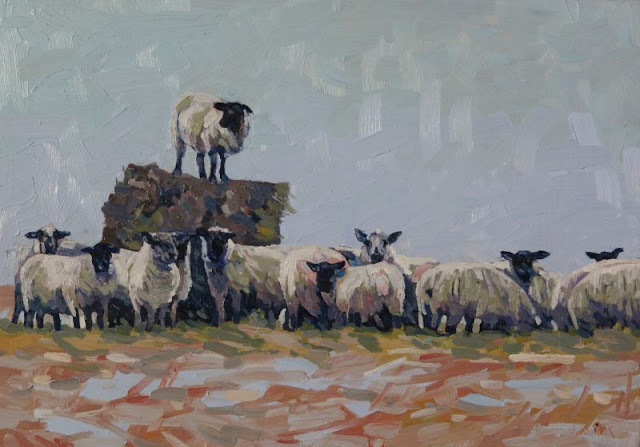

In this painting, one sheep, the Queen of the Ewes, climbed to the top of the round bale to get a better vantage. What was going on? The round bale was of excellent quality and intended to be their midday meal. In this case, it was used as a leg-up to better understand the world. She was looking to the right - from her perspective. Right-wing fascists are very dangerous to sheep.

Another ewe directly in front of the round bale looked intently to the left. Left-wing extremists are just as treacherous. 

These two sheep suspected a sleight of hand and were rightfully wary. The other sheep were inspecting the photographer. They were entertained, simply chowing down and indifferent to everything but the "free lunch". 

The sheep are wise to be wary but what do they do next. I should reread George Orwell's "Animal Farm". That book summary reads a lot like current events. Aldous Huxley also envisioned the future world. Carl Sagan made a forecast as well. There have been a lot of wise people making extremely learned predictions. The sheepy populace was not listening or reading. 

Initially, I had intended to include the political "science" definitions of the various forms of governments - their pros and cons etcetera. Orwell and Huxley were concerned about totalitarian governments based on their experiences with Mussolini and Hitler. Totalitarianism with absolute dictatorship in the hands of one person or party controls every aspect of its politics, economy, education, and culture. An authoritarian regime concentrates power in a leader or an elite not constitutionally responsible to the people. Both are a far step away from democracy. 

Aside from being too long and tedious, the Earth is in the verification phase of the above forecasts of future governments. I reread many of those essays but I realized that the problem is not just the criminal politicians. The future has arrived and the root cause can be found in the sheep.

Huxley was probably closest in writing his 1932 "Brave New World" with that populace controlled with pleasure. We are the problem - blissfully content to live generally peacefully with enough food, shelter and clothing while entertained by sitcoms, crime dramas, sports, gambling and beer. "Only" 10 percent of the world suffers hunger. Oh my, but that is a huge number...

After hard-fought battles to secure the vote, less than two-thirds avail themselves of that privilege. Some who do, are influenced by shallow slogans, sound bites and propaganda - all biased and largely false. "A Buck a Beer" is an improbable election slogan but it worked for the Conservatives in Ontario.

Those who do cast a knowledgeable vote are vastly outnumbered. The "first past the post" method of counting is inherently flawed and unrepresentative of the reality of the populace. Political platform promises to correct that obvious and tragic flaw remain unfilled, influenced no doubt by the real power brokers.

As a result in 2025, the Earth is facing the sixth mass extinction, climate change, forest eradication and destruction of the wilderness. There is big, big money to be made by ravishing the land for fossil fuel, fish, precious metals and anything else that mankind can make a buck from in their artificial economy. Corporations continue to amass unimaginable fortunes. Even individuals are cashing in with the first trillionaire on the horizon. There are a lot of zeroes in a trillion (a dozen). Imagine the madness!

Corporations can be unscrupulously ruthless in their quest for wealth and power. They have the resources not only to purchase countries but more simply and cheaper, to buy the political structures that run them. The three pillars of government include executive, legislative and an independent judiciary. All have affordable price tags. The ultra-rich can acquire world domination just like "Dr. No" in the prophetic 1962 James Bond movie. 

The problem remains with the sheep. We do not hold politicians accountable for their misdeeds and crimes. Oaths of office are quickly forgotten. Political platforms have become increasingly shallow comprised of mud-slinging ads and "vote for me because I'm not the other guy". Instead, world leaders are allowed to pocket envelopes stuffed with cash, dodge taxation, determine their own compensation and accept backroom payments for doing the bidding of wealthy constituents. During a short term in office, ostensibly in the service of the populace, their personal wealth miraculously skyrockets. Upon discovery and getting unelected (if they are caught), the criminal politicians retire to live happily ever after like fairy kings and queens on 100% plus pensions at public expense.

As a result, many former sheep seek political office not to serve and make their country and world a better place, but for personal gain. Self-entitled, narcissistic sheep without character, aspire to become wealthy wolves. The doors to the back rooms are flung wide open "ready for business" for large corporations and wealthy individuals to buy politicians. 

Finding an honest politician, who possesses integrity and empathy with the best interest of the sheep populace at heart, would be wonderful. Sadly there is a general dearth of such character. In fact, a lack of empathy has been correctly labelled as "evil". That word is not nearly emphatic enough to describe destroying the only planet we have or will ever know for wealth and power wielded by the very few. We have arrived at an Earth where the wealthiest 1% of the world's population controls roughly half of the wealth - at least the wealth defined by the artificial manmade economy. 

It is thus consistent that an oligarchy is the prevailing form of government. Absolute power rests with just a small number of people in an oligarchy. Totalitarianism and authoritarianism are similar and equally repulsive but these "leaders" are in it for the cash. Wikipedia summarizes: 

"These people may or may not be distinguished by one or several characteristics, such as nobility, fame, wealth, education, or corporate, religious, political, or military control. Throughout history, power structures considered to be oligarchies have often been viewed as coercive, relying on public obedience or oppression to exist. Aristotle pioneered the use of the term as meaning rule by the rich, contrasting it with aristocracy, arguing that oligarchy was the perverted form of aristocracy." 

           The Sanders Institute provides an apt definition                     
Clearly, an oligarchy is a sinister threat to democracy. The power in government resides in the hands of those not even on the ballot. Meanwhile, the purchased minions go on the glad-handing campaign trail kissing babies, smiling for every camera and ensuring that (taxpayer) money flows freely to their constituents before the polls open. The feigned, friendly faces circulated in the purchased media do not really contain any empathy at all. The sheep buy into the "free" lunch and find the political campaign to be quite entertaining - a mix of gladiators in the stadium, football, tennis and mud-wrestling all rolled into a public display of distraction while the power brokers profit.  Shallow slogans do not address the real issues. The people and the planet continue to pay the freight. 

The power brokers and politicians employ the same techniques as Big Oil and Coal, Big Tobacco, Asbestos and more recently Opioid. The simple playbook has not changed over the centuries:

Lie, confuse, conceal, cheat, obfuscate, distract, divide and conquer.

Manipulate and control the news media and circulate misleading propaganda.

Employ lobby groups with opaque funding and influence or purchase politicians and governments while undermining facts about established science and disguising the reality of their motives. 

Dithering inaction results during which the business of accumulating wealth and power can continue unimpeded, "full steam ahead". The real power players would not benefit from proportional representation so the election system remains archaic. The lack of empathy for planet Earth and all therein displays an evil that defies language to adequately describe. 

The forecasts by Orwell, Huxley, Sagan and many others have verified perfectly more or less. 

Decades were squandered in the efforts to curb greenhouse gases. The Earth is well on its way to becoming uninhabitable reaching temperatures at least 3°Celsius above pre-industrial levels by 2300. The World Meteorological Organization (WMO) confirms 2024 as the warmest year on record with temperatures about 1.55°C above pre-industrial level. "One-point-five" and "net-zero" were simply hollow political shams that allowed big oil corporations to continue business as normal. 

The empathy-void decisions were made in the Exxon Head Offices in the 1970s. James Black, company scientist and climatologist for Exxon clearly stated that "uncontrolled fossil fuel use would cause a "super-interglacial" lasting thousands of years". It would take that long for nature to repair the Earth in the absence of people. (see "Big carbon's strategic response to global warming, 1950-2020") "Drill baby drill" remains the slogan of choice. 
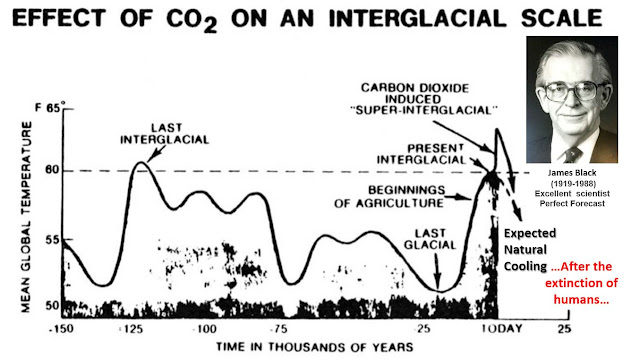
Please note that the above text in red is mine and is not included on James Black's original slide. I am speculating that a climatologist of his stature would make it crystal clear to the group of senior Exxon executives what "Expected Natural Cooling" meant. Carbon could only be re-sequestered if nature recovered and vegetation was allowed to flourish. Convalescence would indeed take thousands upon thousands of years in sharp contrast to the couple of hundred years of the Industrial Revolution. Humans burned and profited (and became essentially extinct) from the extraction of fossil fuels in only a geological blink of an eye. The inherent flaws of an economy that focuses on the profits from extraction while disregarding nature and the life cycle of materials could not be more obvious. Shame. 

The past ten years 2015-2024 are the ten warmest years on record. Six international datasets were used to reach the consolidated WMO global figure below. 2024 was the first calendar year with a global mean temperature of more than 1.5°C above the 1850-1900 average. The impacts are now clearly observable even to the most myopic of sheep. 

This post makes me very sad. It is not my wish or style but sometimes the truth is ugly. I must face myself in the mirror and at least say I failed. I stopped giving Climate Change presentations in 2021. Overhead transparency slides were the first vehicle I used to display the carbon imbalance and the Elsasser Diagram. I graduated to PowerPoint in 1987 and the presentations quickly outgrew the memory of the early computers (AT1, AT2 etc). My generation of meteorologists was ineffective in influencing world leaders. Money talks much louder than science. I was preaching to the choir and the politicians and power brokers were never in the audience. Shame.

The goal of this post is to encourage the reader if there are any, to vote intelligently, read and learn and give critical thought to what you see... it might be AI and misleading at best or outright lies at worst. Be informed with real facts. Hold the feet of your local candidate to the fire and insist on proportional representation. Don't be distracted by any last-minute flow of (taxpayer) cash or the smiling faces in the media photo-op. There is no such thing as a free lunch. We must not be sheep. 

Sadly concerning the climate, the long-term integral of weather, the opportunity to make much of a difference has been lost. The climate system dynamics have a lot of inertia and the tipping point consequences of melting "perma"-frost and land-ice must escalate. The science of this would fill several books to adequately describe. It would take worldwide cooperation and heroics to even tweak the trajectory of spaceship Earth. 

So I sequester myself within the Singleton Sanctuary while caring for nature. The real riches of Earth can be found in the forest, quietly painting and surrounded by nature. Perhaps my art might bring solace to those with no wild place to which to retreat... Now back to 2919 "Queen of the Castle"...

For this and much more art, click on Pixels or go straight to the Collections. Here is the new Wet Paint 2024 Collection. Best wishes for a happy and healthy 2025. 

Warmest regards and keep your paddle in the water,

Phil Chadwick 

Saturday, November 16, 2024

Asperitas

Asperitas image courtesy of Jim Montanus May 4th, 2021 5:28 pm with permission.
Visit https://www.facebook.com/MontanusPhotography 

We live at the bottom of the atmospheric ocean. Clouds and water vapour are the visible evidence of the currents and waves within that relatively shallow fluid. Science can deduce the relative motions of the components of the atmospheric ocean from the characteristics of those cloud tracers. That science is meteorology and when combined with thermodynamics, humans have learnt to forecast the weather. The climate is the time integral of that daily weather. This is the basis for understanding all clouds including asperitas. Clouds are the vocabulary of the weather with novel text freshly printed in the sky every day for all to read and appreciate.  

Weather and climate have always been in a state of flux but what we have been witnessing since the start of the Industrial Revolution is the Anthropocene. Greenhouse Earth has already raced past the 1.5 Celsius "line in the sand" with 3.0 Celsius dead ahead. Climate has considerable inertia and the uncontrolled warming will not stop there. The long-range forecast is for thousands of years of a "Super-Interglacial" period as predicted by James Black in 1977 to the Exxon Oil Executives. 

But let's return to the science behind these dramatic and very interesting clouds!

Asperitas clouds over Burnie, Tasmania, Australia. 
 Credit: © Gary McArthur, Cloud Appreciation Society Member 5353

Actually, asperitas clouds are not that rare. My life surrounded by nature has been spent with my head in the clouds. I have observed these patterns many times and painted them at least twice. As a meteorologist, asperitas tell a weather story of a stable layer, wind shear and an unstable atmosphere above within the relatively warm and moist air where those clouds reside. Normally, atmospheric temperatures decrease with height but this tendency is reversed when the atmosphere warms instead as one climbs through a stable inversion. 

Asperitas clouds form in Kanata, 2024 (Cindy Broderick/X)

Asperitas is a cloud formation first popularized and proposed as a type of cloud in 2009 by Gavin Pretor-Pinney of the Cloud Appreciation Society. Asperitas was added to the International Cloud Atlas as a supplementary feature in March 2017. It is the first cloud formation added since cirrus intortus in 1951 - before I was even born! Asperitas means "roughness" in Latin. A Latin teacher friend told Pretor-Pinney to use the Latin verb "aspero" to name this new cloud, Pretor-Pinney said, because the poet Virgil used it to describe the sea "roughened by the northern winters' gales." Our ground-based view can only observe the undulating bottoms of these dramatic clouds as they ride the inversion. Some science is required to interpret those shapes in terms of what is happening within the clouds!

Large expanses of asperitas are more common with warm frontal inversions which only have a slope of 1 (vertical) to 200 (horizontal). Cold fronts are much steeper with a slope of 1:50. 

The Conveyor Belt Conceptual Model of Mid-Latitude Weather Systems
This graphic illustrates how weather systems harness energy from the jet stream and
details where one is more likely to find aspertas clouds.

Asperitas clouds are associated with a strong flow of warm and moist air - the warm conveyor belt (WCB in the above graphic). Higher elevated asperitas are found above the frontal inversion within the labelled area enclosed by a solid yellow line in the above graphic. The cooler and drier air of the cold conveyor belt lies under that inversion. If that cooler air is moving southward, it is a cold front with the slope of the frontal surface dependent on the speed of the front. Fast-moving cold fronts are steep. If the cold air is shifting northward, it is a warm frontal inversion with a more shallow slope. If the cold air is neither advancing or retreating, the associated front must be nearly stationary. The winds in the cold conveyor belt (CCB in the above graphic) are a function of the intensity and the speed of the approaching system.  

The stability of the inversion is enhanced when the surface is cold like one of the Great Lakes in spring (after winter) or over cold ocean currents like the Californian or Subpolar Gyre that abut the west coast of North America. The low levels of the atmospheric ocean are chilled from beneath thus contributing to the temperature contrast across the inversion and its associated stability. 

This cooling from below can even result in low-level inversion conducive to asperitas without the aid of the front as within the yellow dashed area above labelled as "B" for cooling from Below. 

A 2007 Graphic Illustrating Swells and the Warm Frontal Zone
from an unpublished COMET Module


Atmospheric swells might also contribute to the turbulent shaking of the inversion. Large in both amplitude and wavelength, oceanic swells travel long distances from the storms that generate them. The strong winds found at the source of the swells are not experienced far away where the atmospheric swells can really shake up the low-level inversion contributing to the characteristic asperitas clouds. 

Any instability in the air above the inversion can also dramatically accentuate the gravity wave patterns of the asperitas clouds. Updrafts must also produce downdrafts. These vertical motions would dent and shake the inversion like a giant walking on a taunt bedspread.

My Coriolis Hand illustrates a cyclonic 
swirl with the thumb pointing upward in the
atmosphere in the direction of the ascending
air. Meteorologists also refer to this as 
positive vorticity. 
The strong winds essential to create the sensational shapes of the asperitas also generate wind shear. Shear is when the wind direction and/or speed changes relative to neighbouring flows. Shear is responsible for all swirls witnessed within any fluid. The shear can be oriented in any direction but to keep things simple, meteorologists generally refer to horizontal relative winds as they impact vertical motions in the atmosphere. For example, when cyclonic swirls are advected over air that is not twirling as quickly, air rises, the surface pressure decreases and a relative low-pressure forms. The actual science is a bit more complicated but this is the gist of the process required to make weather. 

The vortices that typify asperitas tend to be chaotically distributed in all directions which makes these clouds so very distinctive.

As a result of the rotation of Greenhouse Earth and the Coriolis Force, the right hand is your Coriolis Hand in the northern hemisphere. Mimicking the cloud curls you witness with the fingers of your Coriolis Hand will point your thumb either up or down. If it is cloudy your thumb will likely be pointing up and you are witnessing a cyclonic swirl conducive to ascending air (as pictured above). 

         Planar satellite view of  warm air advection      
and the associated swirls and lines created 
within the moisture patterns.         
A time-lapse video of asperitas should reveal circulations consistent with the type of air that is moving above the frontal inversion within the warm and moist air. For example, dynamic warm fronts occur when warm air is advected toward the north. Such winds veer with height and must create cyclonic (counter-clockwise) swirls in the atmosphere. With the thumb of your Coriolis hand pointing upward at the red "X" in the accompanying graphic, the sense of rotation within those swirls must be in the direction of your fingers. Any lines (deformation zones) linking these swirls must be in the shape of a "backward S". 

In my experience, surface winds associated with asperitas have been calm or even easterly. These winds are consistent with warm frontal asperitas as a moderate to strong low-pressure system approaches. These deductions are explained in "Weather Lessons for Everyone from the Cold Conveyor Belt Wizard". https://philtheforecaster.blogspot.com/2020/08/weather-lessons-for-everyone-from-cold.html

The strong winds required to produce the most dramatic examples of asperitas are often  associated with Langmuir Streaks. Aligned streets of cloud interact in helical circulations contributing to the apparent chaos of the asperitas cloud patterns. Langmuir Streaks were first identified in the Sargasso Sea in 1927 but the same processes can be witnessed within the atmospheric ocean. See "Langmuir Streaks – Take the time to Observe and Learn from Nature".

Oceanic Langmuir Streaks

Asperitas clouds do not produce much if any precipitation and appear at lower levels in the atmospheric ocean (the low etage beneath 6500 feet above ground level). The lack of precipitation is consistent with the preferred location of these clouds under the anticyclonic companion of the warm conveyor belt - the leading portion of the warm conveyor belt which curls anticyclonically within the atmospheric ocean.  

The question has been asked if the increased number of observations of asperitas might be related to the Anthropocene and Climate Change. Applying thermodynamics to the observed climate warming of 1.5 degrees Celsius already achieved means that the atmosphere can currently hold about 12 percent more water vapour than before. That is a lot of water! More clouds must be the result. 

In addition, a warmer air mass is more likely to be significantly chilled by passing over a cold surface thus creating a significant low-level inversion. This later effect of Climate Change will only be realized until the cold ocean currents falter or large interior lakes stop freezing in the winter. 

Of course, more observations of asperitas might also be the result of a dramatic increase in the number of people with cell phones. 

Do not be concerned! None of the above meteorology will appear on any exam. It is enough to just appreciate the natural world of Greenhouse Earth. Asperitas cloud might be more simply summarized without any science as:

Chaotically undulating gravity wave clouds within a weakly stable frontal inversion characterized by strong and turbulent wind shear within the clouds.  (I am still thinking about these words. The clouds might appear violent and chaotic but at some time and space scale, nature has asperitas neatly organized.)

Artists interested in the sky have witnessed and recorded these clouds before. John Constable (1776-1837) was the first of such artists but did not produce an asperitas painting to my knowledge. His art did contribute significantly to the science of cloud observations that followed but that is another very interesting story about how art and science are one. 

Untitled Lawren Harris painting (and weather observation) circa the late 1920s-1930s

Lawren Harris was the first artist that I am aware of who actually recorded asperitas perhaps as early as the 1920s. Not much is known about that particular painting included above. To my knowledge it is not even named although back then, artists tended not to give titles to their works. I have painted two apseritas weather observations so far and I am not done yet. 

#2510 "Singleton Asperitas" 16x20 by 7/8 inches
Mid-afternoon Tuesday, May 4th, 2021 looking westward across Singleton Lake

The meteorology I described above was confirmed in my own weather observation of asperitas. It was a quasi-stationary frontal weather situation with low-pressure centres of moderate intensity far to the southwest. Quasistationary fronts are typically located east of the low-pressure area where warm fronts are found. The cold air on the north side of the front was neither advancing nor retreating so the surface front remained stationary. 

The Great Lakes were still cold after winter. Even Singleton Lake was too chilly for swimming in early May! The light easterly surface winds were part of the cold conveyor belt drawn into the approaching low-pressure system. The satellite top-down view of the weather did not reveal the beauty of the sky witnessed gazing upward from the ground. 

The weather observation of the afternoon of May 4th, 2021. Singleton Lake is
located at the red star on the map in the lower right of the graphic.

Jim Montanus, a Facebook friend took the following dramatic image of the asperitas over chilly Lake Ontario at about the same time that I was painting the clouds over Singleton Lake about 60 kilometres to the northeast. Jim Montanus' post caused a flurry of comments and excitement. I could not resist adding a bit of an explanation and the science behind the unusual clouds. This post is a continuation of that effort given the recent observations of asperitas.

Note that my painting depicted higher-level asperitas riding above the warm frontal surface while Jim Montanus' photograph shows clouds that appear to be closer to the chilly waters of Lake Ontario. These observations are consistent with the conceptual model proposed above.  
Courtesy of Jim Montanus May 4th, 2021 5:28 pm with permission.
Please visit https://www.facebook.com/MontanusPhotography 

Jim Montanus' image also illustrates how the wind shear oriented at a multitude of different angles can create swirls and rotating tubes with all kinds of intriguing orientations - far more than the simplified vertical interpretation of basic meteorology. All of those patterns can be explained but not without digging much deeper than we have already. Sometimes it is best just to appreciate the beauty and complexity of nature. 

Science is curiosity. Science is a process of investigating, learning more and eliminating errors in our understanding of nature. This story of asperitas is a start and might be improved as we discover more. Nature is always right!

Warmest regards and keep your paddle in the water,

Phil Chadwick